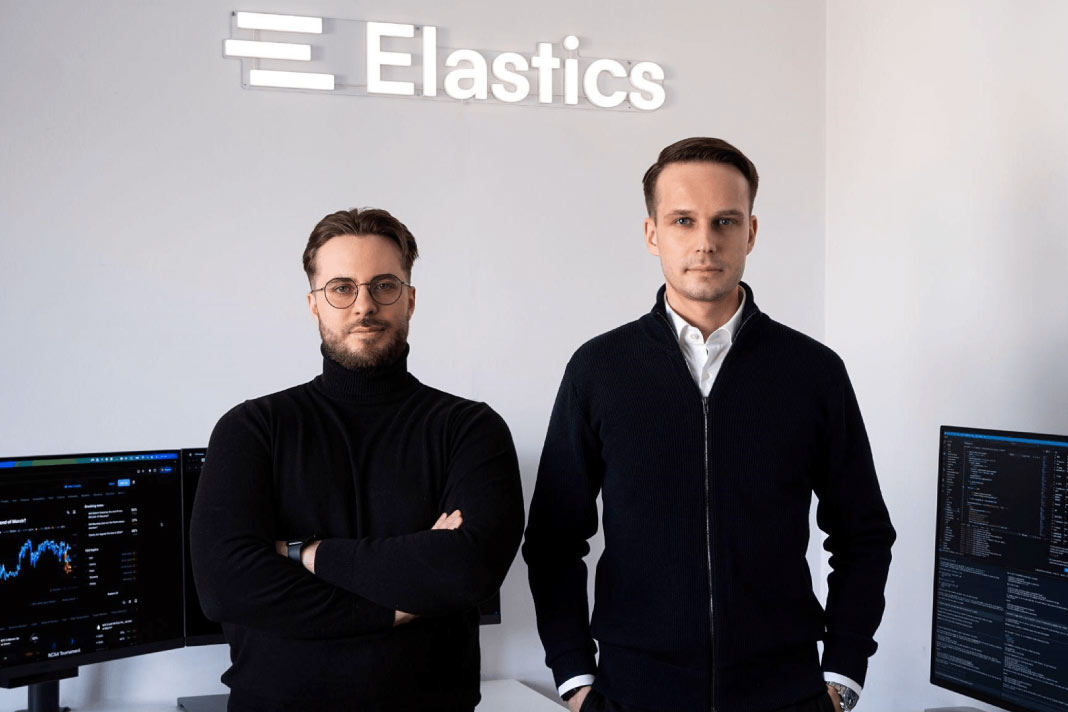


Two founders — one from Goldman Sachs, one from pure mathematics — are betting that the future of trading is a conversation.
Elastics, a Warsaw-based startup building AI-powered infrastructure for quantitative trading, has raised $2 million in an oversubscribed pre-seed funding round led by Frst, a European early-stage venture firm. Angel investors from the AI and crypto sectors, including operators and founders from leading technology companies, also participated.
The raise is small by current funding standards. The ambition is not.
Two Founders, One Thesis
Elastics was founded by Szymon Pawica, a former Goldman Sachs professional, and Mateusz Brodowicz, a mathematician with a background in quantitative modeling. Their central argument is that the tools available to institutional traders — automated research, algorithmic execution, sophisticated portfolio management — have remained largely inaccessible to individual investors, and that artificial intelligence is now capable of closing that gap.
The company is building what it describes as an AI-native operating system for prediction markets, a segment of finance attracting growing attention amid rising valuations at platforms such as Polymarket and Kalshi. Its flagship feature, “Trade with Words,” allows users to define and execute trading strategies in plain language, replacing traditional order forms and manual inputs with conversational interaction powered by large language models.
The product is currently in private beta, with early access available to a selected group of users.
A Market Moment
Prediction markets have moved from niche curiosity to an emerging asset class with notable speed. Yet the tooling available to individual participants has lagged well behind institutional-grade capabilities — a gap that Elastics is explicitly designed to address.
Pawica has noted that as AI-driven automation becomes increasingly embedded in financial markets, the disadvantage manual traders face will only widen. The company’s stated goal is to ensure that access to automation is broadly distributed rather than confined to well-resourced institutional players.
What the Capital Is For
The pre-seed proceeds will be directed primarily toward team expansion, with hiring focused on AI and quantitative talent, as well as continued product development. Over time, Elastics plans to extend its platform beyond prediction markets, building toward a broader infrastructure layer for automated, AI-driven trading.
Whether conversational trading becomes a mainstream behavior or remains a niche proposition will depend on factors well beyond any single startup’s control. But the underlying thesis — that large language models will become the primary interface between users and financial markets — is one that an increasing number of serious investors are beginning to take seriously.
Elastics is making its bet early. The oversubscription of its pre-seed round suggests it is not alone in that conviction.