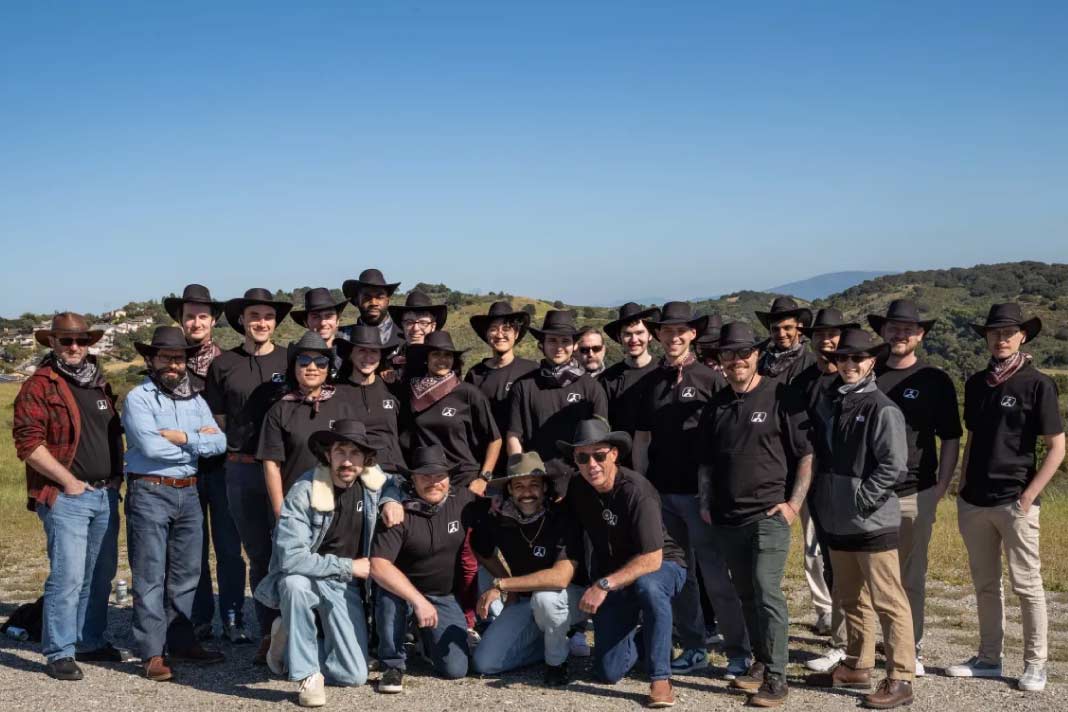


When Baiju Bhatt couldn’t find enough rockets to scale his space data center ambitions, he decided to build one himself.
Baiju Bhatt, the co-founder of online brokerage Robinhood, has raised $275 million to build orbital data centers — and the rocket required to put them there.
The funding, a Series B round led by Index Ventures at a post-money valuation of $2 billion, was announced Tuesday by Cowboy Space Corporation, the company Bhatt founded in 2024 under the name Aetherflux. Breakthrough Energy Ventures, Construct Capital, IVP, and SAIC also participated. The company had previously raised $80 million from Index, Breakthrough Energy Ventures, Andreessen Horowitz, and New Enterprise Associates.
The raise is substantial. The ambition behind it is more so.
From Solar Energy to Space Data Centers to Rockets
Bhatt’s path to rocket development was not a straight line. He launched Aetherflux with plans to harvest solar energy in orbit and beam it down to Earth. The economics of that model led him toward space-based data centers as a more immediate application for orbital power generation. The logistics of that pivot, in turn, exposed a problem he could not solve by conventional means: there are not enough rockets.
Bhatt said he approached multiple launch providers in search of sufficient capacity to scale an orbital data center business at economic costs competitive with terrestrial alternatives. He found none.
“There’s a lot of new rockets coming online, but as we look three, four years out, it’s still very, very scarce,” he said. “You’re going to see a lot of the first-party rocket providers specialize in their own payloads.”
The solution, in Bhatt’s telling, was to bring the rocket in-house. The first launch is targeted for before the end of 2028.
Also Read: Why Most AI Pilots Never Make It to Production
A Crowded and Unforgiving Market
The decision to build a rocket is, by any measure, an audacious one. Only a handful of private companies in the Western world — principally SpaceX, Rocket Lab, and Arianespace — are consistently launching commercial rockets. Blue Origin and United Launch Alliance have spent years attempting to drag their vehicles out of protracted development programs. A number of well-funded startups, including Stoke Space, Firefly Aerospace, and Relativity Space, have worked for years without yet delivering fully operational systems.
Cowboy Space is entering direct competition with SpaceX and Blue Origin, the most advanced and best-capitalized players in the market.
Bhatt is undeterred. “The prize here, and the size of this market, is big enough that there’s room for many players to succeed,” he said. “I see the demand for AI getting more and more acute, and I see the options on Earth getting more and more limited.”
The Design Logic
Cowboy Space’s rocket is purpose-built for a single payload type, which Bhatt argues simplifies development considerably. Rather than designing a general-purpose launch vehicle, the company plans to build its data centers directly into the second stage of its rocket — a concept that echoes Explorer 1, the first American satellite, which was constructed as the final stage of its launch vehicle and packed with scientific instruments.
Each satellite is expected to have a mass of 20,000 to 25,000 kilograms and generate 1 megawatt of power to power approximately 800 onboard GPUs. The rocket would be slightly more powerful than SpaceX’s Falcon 9 workhorse, though smaller than the still-developmental Starship. Bhatt expects the booster stage to eventually be reusable.
The company has hired veterans from across the industry, including Warren Lamont, a former propulsion engineer at Blue Origin, and Tyler Grinnell, a former launch director at SpaceX. Cowboy Space also plans to develop its own rocket engine — the most technically complex and expensive component of any launch vehicle. Key development infrastructure, including facilities for testing, manufacturing, and launching, is still being established.
Also Read: Healthcare Is Scaling AI Without the Infrastructure to Manage It
The Broader Race
Cowboy Space is not alone in identifying orbital computing as the next frontier for AI infrastructure. Google’s Suncatcher program is targeting the mid-2030s for the deployment of space-based data centers. Starcloud is pursuing a near-term strategy focused on edge processing for space sensors. Both are contingent, to varying degrees, on the commercial availability of heavy-lift launch capacity that does not yet reliably exist.
SpaceX’s Starship, widely seen as the vehicle most likely to unlock orbital data center economics at scale, is expected to conduct its 12th test flight imminently. But even once operational, it may take years before Starship capacity becomes commercially available, given SpaceX’s satellite deployment priorities. Blue Origin’s New Glenn rocket failed to deliver a satellite during its third launch in April.
For Bhatt, the launch capacity gap is not a temporary inconvenience. It is the market. And Cowboy Space, with its new name and its new mustache-wearing chief executive, is betting $275 million that building the rocket is the only reliable way through it.