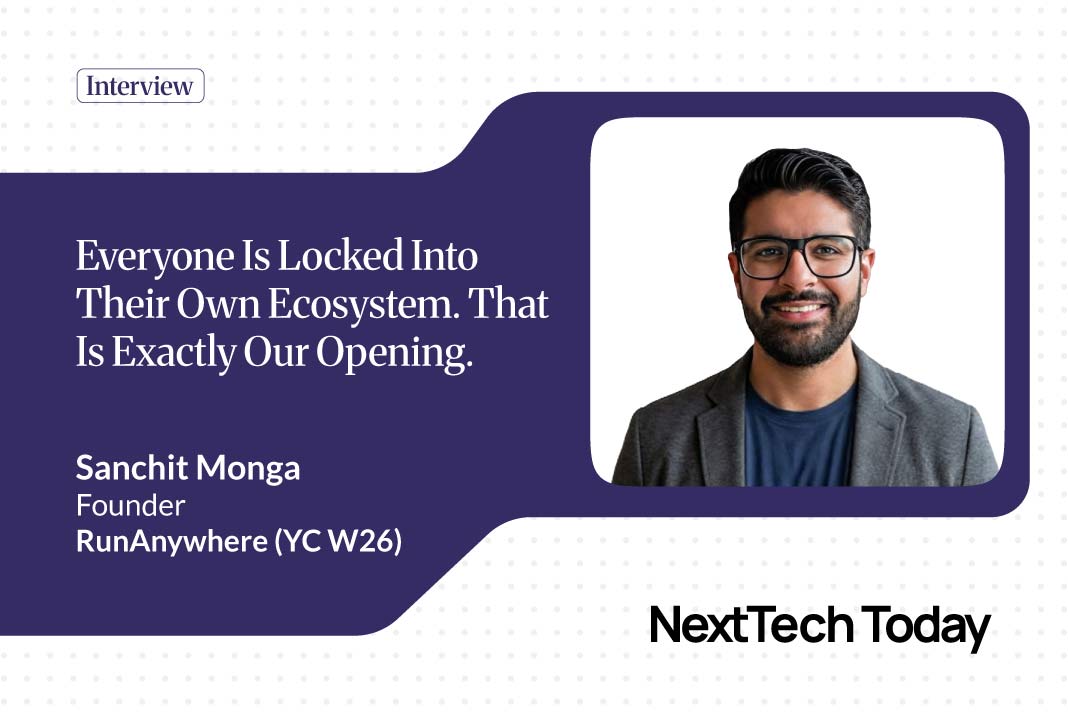

Sanchit Monga, founder of RunAnywhere (YC W26), believes the hyperscalers have left a gap that no one else is positioned to fill. He intends to fill it — for every device, every industry, every model.
The artificial intelligence industry has, for the better part of a decade, been organized around a single gravitational assumption: that intelligence lives in the cloud. The hyperscalers — Amazon, Google, Microsoft, and the hardware empires built alongside them — constructed a trillion-dollar architecture on that premise. Data travels up. Compute happens there. Results come back down.
Sanchit Monga is betting that the assumption is beginning to crack.
Monga is the founder of RunAnywhere, a Y Combinator W26 startup building infrastructure that allows AI models to run entirely on-device — on smartphones, laptops, and edge hardware — without a round-trip to the cloud. The pitch is not simply about privacy, though that is part of it. It is about latency, data sovereignty, regulated industries that cannot afford to send sensitive information to a third-party server, and enterprises that want to deploy their own proprietary models at scale without becoming dependent on Apple’s ecosystem, or Google’s, or anyone else’s.
Monga speaks with the velocity of someone who has been living inside this problem long enough to have strong opinions about everything — and the candor of someone who has not yet learned to sand them down for public consumption. He arrived at the conversation without prepared remarks and without apparent need for them.
We spoke about the hyperscalers, the limits of the privacy promise, India’s device fragmentation problem, and whether RunAnywhere intends to be a household name or the invisible engine inside the device in your pocket.
Excerpt from the interview;
The cloud giants built a trillion-dollar industry on centralization. Are you arguing that Jensen Huang and the hyperscalers have the AI map entirely wrong?
Not at all. NVIDIA is already investing in edge AI — speech-to-text models, smaller physical AI models, and hardware for robotics. Google has Lite RT. Meta has their own edge framework. Apple has its own on-device stack. The big players know where things are going.
The problem is that each of them is building for their own ecosystem. That is rational for them — but it means no one is building the cross-platform layer that works across all of them. That is the gap we are in.
Privacy is your biggest selling point, but on-device AI still runs models trained on cloud infrastructure — often on data of questionable provenance. Isn’t private inference a narrower promise than most users realize?
We operate at the inference and infrastructure layer — not the model layer. What data a developer trains on, which model they deploy — that is their decision entirely. We provide the platform to ship it.
Cloud AI went through the same arc. GPT-3.5 launched, thousands of applications were built on top of it, and only years later did the industry seriously grapple with security, governance, and compliance. On-device AI will follow the same path. Those questions will matter more as the space matures.
We are also a hybrid platform — routing to the cloud when a query demands it, keeping it local when the data is sensitive. The architecture is practical, not ideological.
You are building for regulated industries — healthcare, finance, and aviation. Those sectors move cautiously and demand certifications that take years. How does a new startup close that credibility gap?
Open source. Anyone from a regulated industry can read exactly what we have built. The only proprietary part is the inference layer — how models run efficiently on constrained hardware — and that has nothing to do with regulatory concerns.
What those industries need to audit is the data flow: where information goes, how the infrastructure is orchestrated, and what the system does with a query. All of that is visible. We are an open book.
India is central to your market narrative, but India’s device fragmentation is also your hardest engineering problem. Opportunity or obstacle?
Opportunity. If we solve for India’s fragmentation, we will be the only team in the world to have done so at that scale. We are already partnered with Qualcomm and have the best inference platform for Apple silicon — that covers more than 70 percent of devices. The rest is capturable.
Most AI infrastructure companies look at India’s device landscape and walk away. We see a market that, once cracked, nobody else can replicate.
OpenAI, Google, Apple, and Qualcomm are all pushing on-device AI. What does RunAnywhere have that they don’t?
An enterprise in healthcare or defense wants to train its own model on its own data — data they will not hand to anyone. Then they need a platform to ship that model across every device they run, regardless of manufacturer.
Apple will not build that for Samsung. Google will not build it for Apple. No hyperscaler has an incentive to solve for everyone else’s hardware. So enterprises end up managing multiple solutions across multiple ecosystems. We remove that problem entirely. That is what we have that they do not.
Rapid Fire;
Speed or privacy — if RunAnywhere could offer 10 percent more of one, which wins?
Speed. Enterprises are sending enormous volumes of data to external servers every day and nobody is losing sleep over it. Privacy is the real value proposition for regulated industries — for everyone else, performance closes the deal. We believe in privacy more than most. But the market has been clear.
Most overrated buzzword in AI right now?
Reinforcement learning environments. Half the industry says RL is dead. The other half says it might still work. We will find out.
Silicon Valley or Bangalore — where is the real edge computing innovation happening in 2026?
Silicon Valley. There is one company in Bangalore doing something worth watching — but the serious players, the hardware companies, the capital — it is all here.
In five years, household name or an invisible engine inside every smartphone?
Household name. But if everyone knows RunAnywhere, it means everyone is using it. So maybe those are the same answer.
RunAnywhere is currently in its early stages. The gap Sanchit Monga has identified — between ecosystem-locked on-device solutions and the cross-platform infrastructure no single giant has an incentive to build — is real. Whether his company is the one to fill it is a question the market will answer. Monga has already decided.