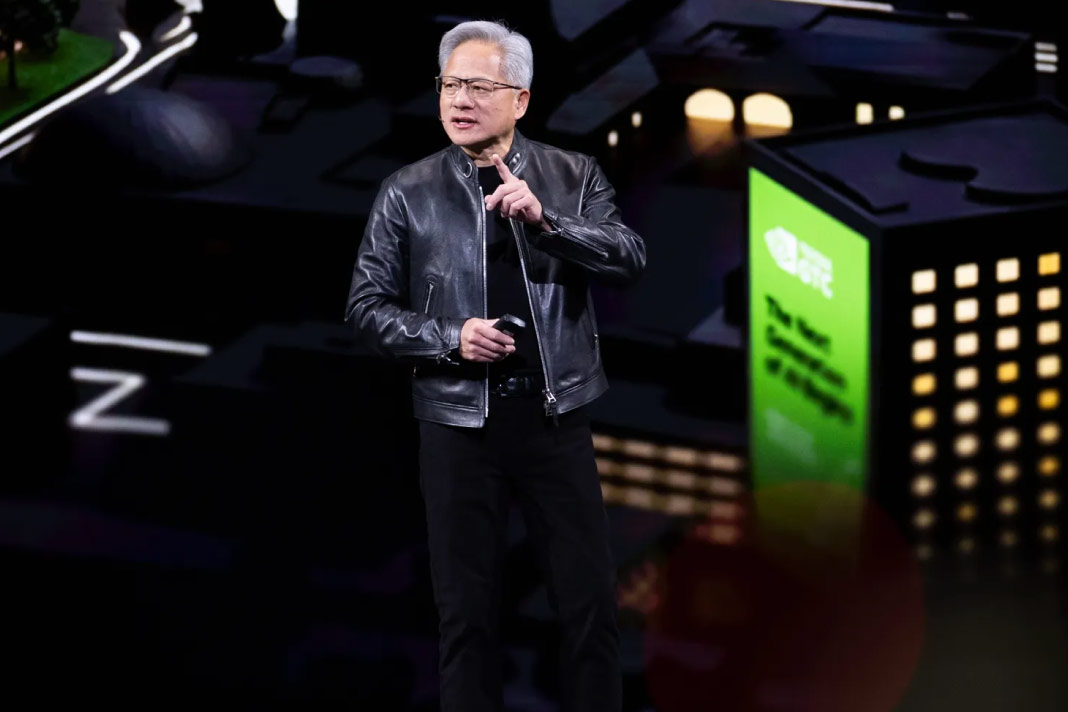


Nvidia CEO Jensen Huang said at GTC 2026 that he expects at least $1 trillion in revenue from Blackwell and Vera Rubin chips through 2027, as AI shifts from training to inference.
Nvidia Chief Executive Officer Jensen Huang said Monday that he expects the company to generate at least $1 trillion in revenue from its newest artificial intelligence chips through 2027 — and that even that figure will likely prove conservative.
Speaking at Nvidia’s GTC 2026 conference in San Jose, Huang said the projection covers sales of the company’s current Blackwell chips and its next-generation Vera Rubin line. In October 2025, he had disclosed $500 billion in AI chip orders through 2026. Monday’s figure more than doubles that threshold over a slightly longer horizon.
“I am certain computing demand will be much higher than that,” Huang said.
Nvidia sits at the center of the AI infrastructure market, providing the processing chips that power large language models including OpenAI’s ChatGPT and Anthropic’s Claude. The company’s position has grown more entrenched as the AI economy moves from the training phase — in which models are built — into inference, in which those models are put to productive use at scale, a transition that demands increasingly powerful and specialized hardware.
“Finally, AI is able to do productive work, and therefore the inflection point of inference has arrived,” Huang said.
He noted that all of Nvidia’s own software engineers now use AI coding assistants, citing Anthropic’s Claude Code and OpenAI’s Codex as examples. The company plans to combine its Vera Rubin chips with storage, inference accelerators and Ethernet racks into an integrated system it is calling an AI supercomputer, designed to deliver what Huang described as a “generational leap” in agentic AI capabilities.
The Rise of OpenClaw
A significant portion of Huang’s keynote was devoted to OpenClaw, an open-source AI agent framework developed by programmer Peter Steinberger that has gained rapid adoption since its release. Huang called the project “profound” and said it has become the most popular open-source project in the history of software development, surpassing Linux in adoption in a matter of weeks.
Nvidia announced NemoClaw, a tool built on its existing agent toolkit that allows users to interact with OpenClaw while adding enterprise-grade security controls. Huang told the audience that every company now needs an OpenClaw strategy.
Also Read: Amazon’s Layoffs Aren’t a Warning. They’re a Preview.
What Comes After SaaS
Looking further ahead, Huang predicted that the software-as-a-service business model — which investors have worried will be undermined by AI agents that can perform tasks previously requiring dedicated software — will not disappear but transform. Rather than selling software licenses, companies will sell agents that help clients build and operate software themselves, a model Huang termed “agentic AI as a service.”