
Vlada Musvydaite Vilciauske built Walk15 from a single 15,000-step route into a platform reaching 31% of Lithuania’s population and one million users globally.
In 2016, Vlada Musvydaite Vilciauske felt like a bad mother. She did not know where to take her children for a walk.
So she created a route — a 15,000-step path designed with a regional park official — and noticed something she had not expected. Walking with a clear goal changed the experience entirely. People stayed engaged. One participant lost 15 to 20 kilograms simply by following it. A question followed naturally: how could she share this with everyone else?
The answer became Walk15, a platform that now reaches approximately 31% of Lithuania’s population, counts more than one million app users worldwide and generated around €1 million in revenue last year. What started as a personal frustration has grown into a business operating across 1,500 companies in multiple countries, with an additional entity established in Berlin and a recently announced initiative with the European Central Bank.
Steps as Currency
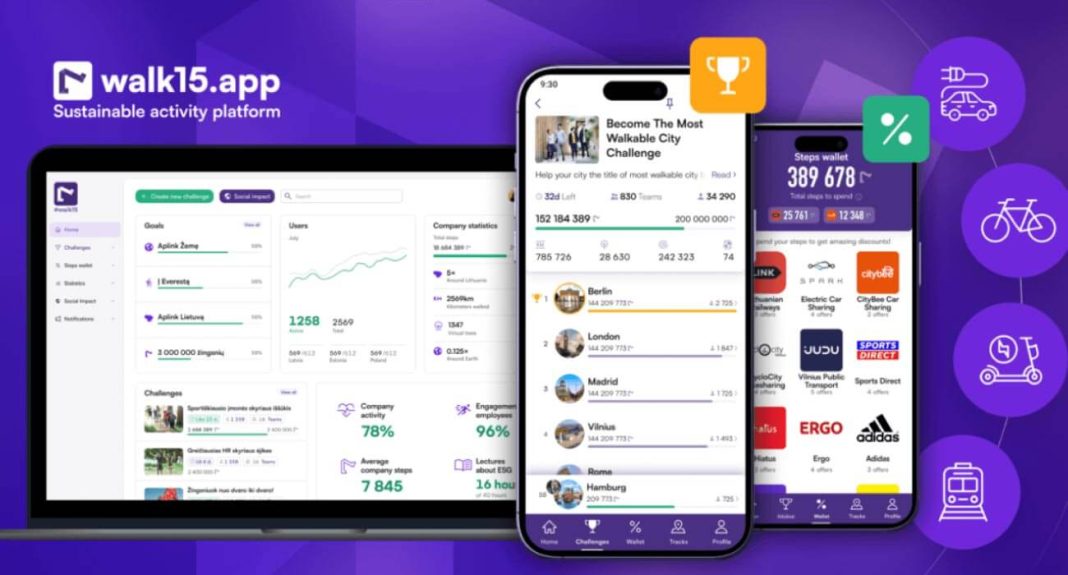
The platform’s core mechanic is straightforward. Users connect a phone or wearable device, their steps are tracked without collecting location data, and the steps accumulate in a digital wallet. Those steps can then be exchanged for tangible rewards — a grocery discount on healthy items for 20,000 steps, airport fast-track access, discounts at Adidas — through challenges created by companies, cities and organizations.
The business model primarily sits in the business-to-business and business-to-government spaces. Organizations pay to create customized, goal-driven step challenges for their employees or communities, combining health, sustainability and behavioral change objectives into a single campaign. The European Central Bank recently ran a Walk15 initiative in which participants walked while receiving financial literacy content, with users across different countries competing on total steps accumulated.
“We are not a typical SaaS company, and we’re not a simple consumer app either,” Vilciauske said. “That makes it difficult for some investors to categorize us. Some see us as a community project, others as a health app — but we’re building something different.”
Also Read: “The AI Economy Has Moved From the Training Phase Into the Inference Phase,” Says Jensen Huang
Motivation, Not Tracking
Vilciauske is emphatic that Walk15 is not a step counter. The distinction matters to her both philosophically and commercially.
“We are a motivation and initiative platform,” she said. “Every organization — whether it’s a company, a city, a sports club, or even a government — has the same challenge: how do you engage people?”
The platform also creates community-driven initiatives — walking challenges that support animal shelters, dog-walking competitions and campaigns tied to charitable donations. The target audience extends explicitly to younger users: around 80% of children and teenagers do not move each day enough, Vilciauske said, and Walk15 sees that as both a problem and an opportunity.
“Ten thousand steps are for your health, five thousand steps are for your education,” she said. “This is where we can really create impact.”
The Founder’s Background
Vilciauske was born in Ukraine and spent most of her life in Vilnius. She came to movement through sport — she was a 400-metre runner who became a Lithuanian and European-level champion, following a mother who was a 100-metre champion and a father who ran 800 metres. She describes herself as almost “designed” for the track.
But what stayed with her was not the competition. It was something her mother told her. “The most important thing in life is whether you are happy, not how much money you make,” she recalled. “That philosophy stayed with me, and it’s one of the reasons I created Walk15.”
Also Read: Black Hat USA 2025: A Glimpse into the Future of Cybersecurity
What Comes Next
Walk15 is building AI into its platform to allow organizations to generate campaigns automatically. An HR manager would describe a challenge objective and the system would produce everything — messaging, engagement mechanics, timing — drawing on the behavioral data the platform has accumulated about what actually motivates people to move.
The company is also expanding its support for nonprofit organizations through donation features that allow users to contribute to causes through their physical activity.
Vilciauske’s long-term ambition is less a business target than a behavioral one. “We want people everywhere to move more, feel part of a community, and contribute to something meaningful,” she said. “It’s not about walking 15,000 steps. It’s about taking the first step — and changing behavior over time.”